
If you’re evaluating commercial cleaning services for the first time — or trying to figure out why your current provider keeps missing things — you’ve likely hit the same wall: most companies list “office cleaning” without telling you what that actually means.
This guide breaks down exactly what professional commercial cleaning services in the Bay Area typically include, what counts as a standard task, what falls into the add-on category, and how to read a cleaning scope of work so you’re never surprised. After 26 years serving Bay Area and Tri-Valley facilities, we’ve seen every variation of this question — and the answer matters more than most people realize.
What Standard Commercial Cleaning Covers
Standard recurring commercial cleaning is the foundation of any janitorial service contract. These are the tasks completed at every visit, whether daily, three times per week, or weekly depending on your facility’s traffic and needs.
1. Restrooms
Restrooms are always included in standard scope. A thorough restroom clean covers scrubbing and disinfecting toilets, urinals, sinks, and mirrors, restocking soap and paper supplies, emptying trash, and wiping all surfaces. High-traffic restrooms in East Bay office buildings and medical suites often require daily service to stay compliant and presentable.
2. Common areas and lobbies
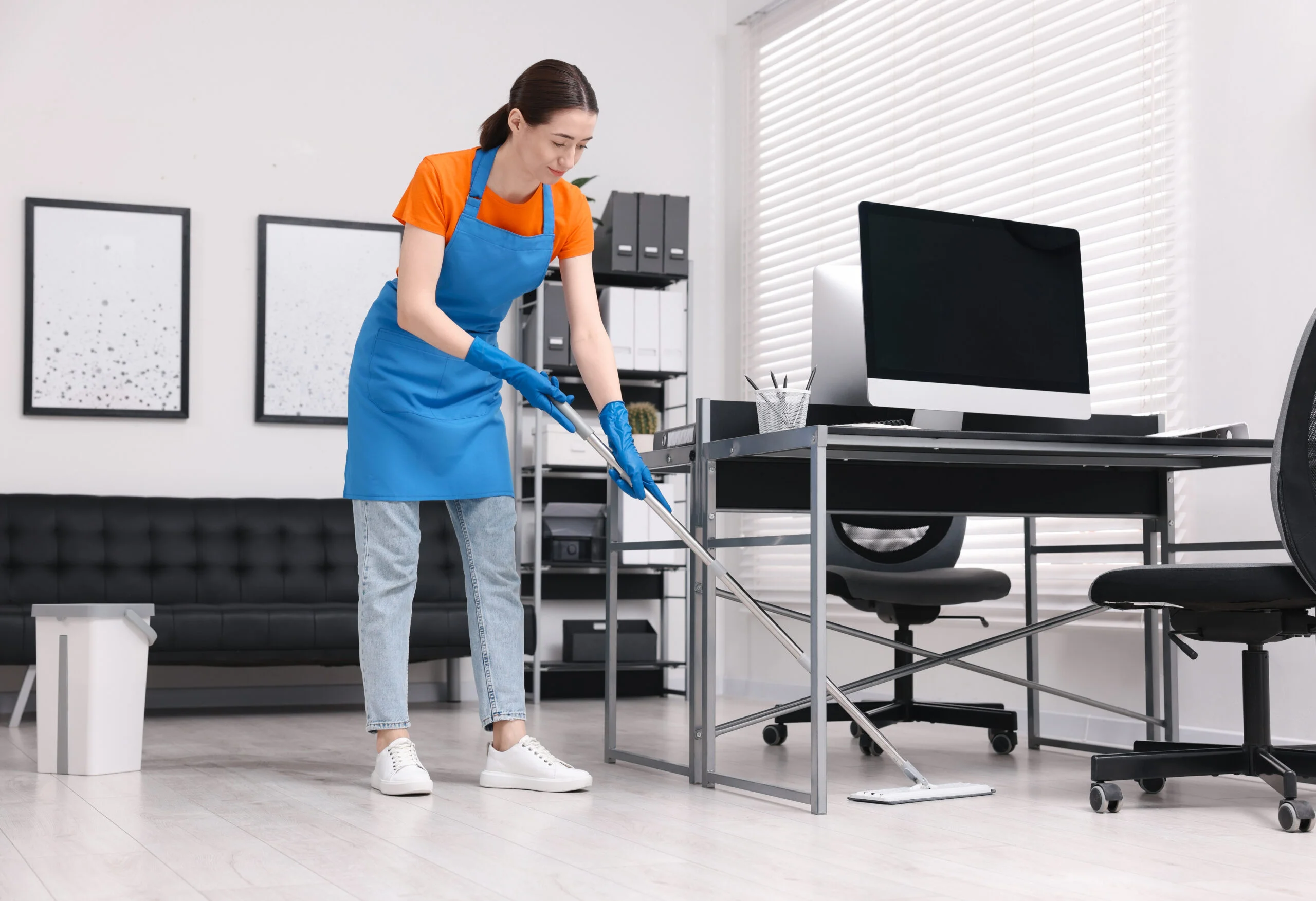
Common areas and lobbies receive dusting, vacuuming or mopping, trash removal, and surface wipe-downs. These areas shape the first impression clients and visitors form when they walk through your door.
3. Office workspaces
Office workspaces include surface dusting, desk and countertop wiping, trash liner replacement, and vacuuming of carpeted areas. Detail desk organization or personal item cleaning is typically excluded unless specifically requested — a clear scope of work protects both parties.
4. Break rooms and kitchens
Break rooms and kitchens require counter cleaning, appliance exterior wiping, sink sanitation, and trash removal at every visit. Interior appliance cleaning — refrigerator interiors, microwave interiors — is generally considered an add-on or periodic service.
5. High-touch point disinfection
High-touch point disinfection has become a standard line item since 2020 and remains essential. Door handles, light switches, elevator buttons, shared equipment, and reception surfaces all harbor pathogens at much higher rates than flat surfaces. Bay Area businesses in healthcare, property management, and education sectors now treat this as non-negotiable.
Periodic Services: What Gets Scheduled Separately
Beyond daily and weekly tasks, professional commercial cleaning programs include periodic services on a monthly, quarterly, or as-needed basis. These are not typically included in base pricing — but they should be planned for in your facility’s maintenance schedule.
Floor care and polishing is one of the most commonly overlooked periodic services. Routine mopping maintains hygiene, but stripping, waxing, and burnishing hard floors protects your investment and extends floor life significantly. High-traffic corridors in Bay Area office buildings can deteriorate rapidly without it.
Professional carpet cleaning via hot water extraction removes deep-set allergens, bacteria, and embedded soils that daily vacuuming can’t reach. Most commercial facilities benefit from extraction cleaning one to four times per year depending on foot traffic and industry type.
Window cleaning is typically scheduled monthly or quarterly for interior surfaces and periodically for exterior glass. Exterior windows are usually scoped separately from janitorial and require specialized equipment and safety protocols.
Deep cleaning services — high dusting, vent and baseboard cleaning, partition detail, grout scrubbing — are performed less frequently but address areas standard cleaning deliberately skips to stay time-efficient. Scheduling a deep clean at least twice annually prevents gradual buildup that becomes expensive to correct.

How Specialty Facilities Change the Scope
Not every cleaning program is built the same. The tasks, products, and protocols that apply to a standard office look very different from what a medical facility or dialysis center requires.
In regulated environments, providers must work with EPA-certified disinfectants, follow CalOSHA bloodborne pathogen protocols, and often maintain detailed service logs for compliance audits. Standard cleaning crews without this training shouldn’t be working in medical suites, and facility managers should ask directly about certifications before signing any contract.
Our color-coded microfiber cross-contamination prevention system is a direct response to this challenge. Each color is assigned to a specific area type — restrooms, kitchens, general surfaces — so no cloth or mop head ever carries bacteria from one zone to another. It’s a protocol that matters in every facility, but it’s critical in healthcare environments.
If your facility requires a day porter during business hours — for common area upkeep, restroom checks, or spill response — that’s typically scoped as a separate service from after-hours janitorial. Many Bay Area property management offices and multi-tenant buildings find day porter coverage essential for maintaining standards throughout the day, not just overnight.
What to Look for When Reviewing a Cleaning Scope
Reading a commercial cleaning proposal carefully before signing prevents scope disputes later. A few things to verify:
Task frequency should be explicit. Know which items are daily, weekly, monthly, and periodic. “Regular cleaning” without defined frequencies is a red flag.
Supplies and consumables. Confirm who provides restroom supplies, trash liners, and cleaning products. Some contracts include them; others bill separately.
Supervision and accountability. Ask whether a dedicated account supervisor is assigned to your facility, what the inspection cadence looks like, and how service failures are addressed. At YSMS, every account includes a named supervisor responsible for quality control — our 98% client retention rate is a direct result of that accountability model.
Satisfaction guarantees. A credible commercial cleaning provider should stand behind their work. Our 100% satisfaction guarantee means if something is missed, we return to re-clean within 24 hours at no charge.
Contract terms. Month-to-month agreements protect you if service quality declines. Long-term locked contracts offer little recourse when problems arise.
Get a Scope That Actually Fits Your Facility
The right commercial cleaning program isn’t a template — it’s built around your facility’s square footage, traffic patterns, industry requirements, and budget. Bay Area and Tri-Valley businesses deserve a cleaning partner who can walk your space, ask the right questions, and put together a scope with zero guesswork.
Call YSMS at (510) 731-8447 or request a free facility walkthrough at yoursolutionms.com. We’ll build a custom cleaning plan with complete transparency on what’s included, what’s periodic, and what’s excluded — so you always know exactly what you’re getting.
Frequently Asked Questions
Janitorial services typically refer to routine, recurring maintenance tasks — trash removal, restroom sanitation, mopping, and surface cleaning. Commercial cleaning is a broader term that encompasses janitorial work plus specialty services like floor care, carpet extraction, window cleaning, and deep cleaning. In practice, many Bay Area providers use the terms interchangeably, so always ask for a full task list rather than relying on the label.
Yes — disinfection of high-touch surfaces like door handles, light switches, and shared equipment is now considered part of standard commercial cleaning scope. However, the frequency and products used vary by provider. Facilities with compliance requirements, such as medical offices, should confirm that EPA-certified disinfectants are used and that protocols align with CalOSHA standards.
Most offices in San Ramon, Pleasanton, and the broader Tri-Valley schedule cleaning two to five times per week. Higher-traffic facilities — medical suites, multi-tenant lobbies, daycares — often require daily service. Frequency depends on headcount, facility type, and the impression standards you need to maintain for clients or patients.
No — these are typically periodic add-on services billed separately from recurring janitorial. Standard service covers vacuuming and mopping; deep floor care (stripping, waxing, buffing) and carpet extraction are scheduled on a monthly or quarterly cycle. Ask your provider to include these in a separate maintenance schedule so they don't get overlooked.
Common exclusions include interior appliance cleaning (inside refrigerators and microwaves), detailed desk organization, personal item handling, exterior window washing, ceiling or overhead duct cleaning, and biohazard or hazmat remediation. In Fremont, Dublin, and Livermore, many facilities request a written exclusions list upfront so there's no ambiguity at billing time.
Ask specifically about CalOSHA bloodborne pathogen compliance training, EPA-certified product usage, and experience with regulated healthcare environments. Request references from similar facility types. YSMS has specialized in dialysis centers and medical facilities for over 26 years — it's a distinct credential that general janitorial providers cannot match.