
Your office might look spotless after the nightly sweep, but looks can be deceiving. Beneath that tidy surface, certain spots are quietly hosting bacteria, viruses, and pathogens that cycle through your workforce with every workday. For Bay Area facility managers and office administrators, understanding where germs actually accumulate — and why daily attention is non-negotiable — is the first step to a genuinely healthy workplace.
Most businesses focus their cleaning energy on the obvious: vacuumed carpets, wiped-down conference tables, and emptied trash cans. But the surfaces your team touches most are often the ones that receive the least attention. The result is a predictable pattern: flu spreads through an open office in two weeks, cold season hits every department simultaneously, and sick days pile up . Over 26 years serving Bay Area and Tri-Valley businesses, the team at YSMS has developed a clear picture of where germs live in commercial spaces — and more importantly, how to eliminate them before they become an employee health crisis.
Why Office Germ Hotspots Drive Sick Days and Lost Productivity
High-touch surfaces in a typical office accumulate germs throughout the day, not just overnight. Every person who presses an elevator button, opens a breakroom door, or answers a shared phone deposits whatever was on their hands onto that surface — and picks up whatever was left by the person before them.
The problem compounds in open-plan offices, co-working environments, and dense Bay Area tech campuses where dozens of employees share equipment, common areas, and airspace. California businesses are also subject to Cal/OSHA’s Injury and Illness Prevention Program (IIPP) requirements, which obligate employers to identify and correct health hazards in the workplace. Unmanaged germ hotspots can expose your business to compliance risk alongside the obvious health consequences.
Daily professional cleaning, particularly of the five hotspots below, creates a documented, repeatable defense against pathogen spread. This is especially important for medical offices, dialysis centers, and facilities serving vulnerable populations — environments where our janitorial services team holds specialized protocols that go well beyond standard commercial cleaning.
The 5 Germ Hotspots That Need Daily Disinfection
Here are the five surfaces and zones that require daily professional attention in virtually every commercial office — regardless of industry or headcount.
1- Shared Technology: Keyboards, Mice, and Desk Phones
Office keyboards and desk phones are among the most bacteria-laden surfaces in any workplace. Employees interact with these devices constantly — often while eating, after coughing, or without washing their hands after touching common surfaces. The keys and crevices of a keyboard create dozens of small spaces where bacteria settle and multiply between cleanings.
Desk phones add a second layer of risk because they combine hand contact with face and mouth proximity. Any pathogen on the handset can transfer directly to a user’s respiratory system. For shared workstations — particularly common in Bay Area co-working spaces and hybrid offices — the risk multiplies with every shift change.
Daily disinfection with EPA-registered products is the correct response. YSMS crews use a color-coded microfiber system that ensures the same cloth used on a bathroom surface never touches a breakroom or workstation. That cross-contamination prevention detail makes a measurable difference in actual pathogen load across a facility.
2- Door Handles, Light Switches, and Chair Arms
Every employee touches door handles and light switches dozens of times per day — yet these surfaces rarely appear on basic daily cleaning checklists. In a typical office with 30 employees, a single door handle might be touched 200 or more times before it gets wiped down.
Chair arms carry a similar risk. They are touched continuously throughout the workday and almost never make it onto a standard daily checklist. In conference rooms, multiple occupants share the same chair arms across back-to-back meetings with no cleaning in between.
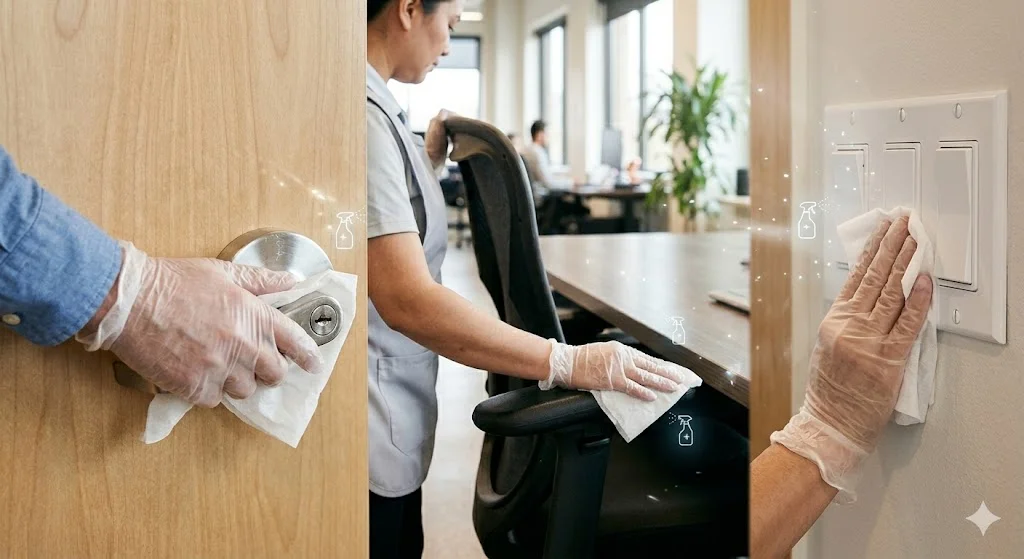
Disinfecting these high-contact surfaces daily — with appropriate dwell time to actually kill pathogens rather than just moving them around — requires trained, consistent crews. YSMS account supervisors verify this work is completed to standard on every visit, which is why our clients maintain a 98% retention rate. Accountability is built into the model.
3- The Breakroom and Kitchen Surfaces
Office breakrooms concentrate multiple germ risks in a single, high-traffic space. Refrigerator handles, microwave buttons, coffee machine handles, sink faucets, and countertops all accumulate bacteria from food handling, unwashed hands, and shared use across an entire shift.
Food residue compounds the problem. Crumbs and spills that aren’t addressed immediately create a nutrient environment that accelerates bacterial growth. In Bay Area offices where employees often eat lunch at their desks or prep food in a shared kitchen, this cycle plays out every day.
Professional breakroom cleaning should address all appliance handles, sink surfaces, countertops, and floors with food-safe disinfectants. For facilities in Tri-Valley commercial parks where breakrooms serve large staffs, our commercial cleaning team can schedule midday touch-ups in addition to after-hours deep cleaning to maintain hygiene throughout the business day.
4- Shared Office Equipment: Copiers, Printers, and Conference Room Tech
Printers, copiers, conference room touchscreens, and shared tablets are handled by many employees but cleaned by almost none. The buttons and touchscreens on these devices collect oils, skin cells, and pathogens from every hand that interacts with them — and they’re typically overlooked during standard office cleaning routines.
In Bay Area offices where conference rooms cycle through multiple teams in a single day, the AV touchscreens, remote controls, and speakerphone units on conference tables deserve the same daily attention as bathroom fixtures. They arguably carry higher germ loads because no one assumes responsibility for cleaning them.
Adding shared equipment surfaces to a daily disinfection protocol requires a systematic approach. YSMS crews work from a facility-specific checklist that covers every surface agreed upon during an initial walkthrough — so nothing gets missed because it falls outside the obvious cleaning zones. Our customized cleaning plans are built around how your facility actually operates.
5- Restrooms: Beyond the Obvious Surfaces
Restrooms receive the most attention in any office cleaning program — but the most dangerous surfaces aren’t always the most obvious ones. Faucet handles, soap dispenser pumps, paper towel dispensers, stall door locks, and toilet flush levers are touched by every restroom user, often with unwashed hands, and transfer pathogens directly to the next person.
The moisture environment in restrooms also accelerates bacterial multiplication. Surfaces that remain damp between cleanings — around sink basins, near floor drains, and under paper towel dispensers — become active breeding grounds rather than passive collection points.
Daily professional restroom cleaning with hospital-grade disinfectants, combined with midday touch-up service for high-traffic facilities, keeps pathogen levels genuinely low rather than cosmetically acceptable. For medical facilities, dialysis centers, and schools, our professional cleaning services team applies stricter protocols that meet facility-specific compliance standards.
Stop Germs Before They Stop Your Team
Bay Area and Tri-Valley businesses deserve a cleaning partner that understands where germs actually live — not just where they’re assumed to be. At YSMS, our dedicated crews follow facility-specific checklists, use EPA-registered products with verified dwell times, and operate under an account supervisor model that ensures consistent results every visit. We back every service with a 100% satisfaction guarantee and a free re-clean within 24 hours if anything doesn’t meet your standard.
Whether you manage a single-floor office, a multi-building campus, or a medical facility anywhere in the East Bay, we’ll conduct a free facility walkthrough and build a cleaning plan around your actual risk profile.
Call us at (510) 731-8447 or request your free quote online to get started.
Frequently Asked Questions
The highest-germ surfaces in most offices are keyboards, desk phones, door handles, breakroom appliance handles, shared copier and printer buttons, and restroom faucet handles. These surfaces are touched repeatedly throughout the day and are often overlooked during standard cleaning routines. Daily disinfection of these hotspots is the most effective way to reduce pathogen spread across your workforce.
High-touch surfaces like door handles, shared electronics, and breakroom appliances should be disinfected daily at minimum — and ideally multiple times per day in high-traffic facilities. Lower-touch surfaces can be addressed on a weekly or biweekly schedule. Professional cleaning crews can tailor disinfection frequency to your specific office layout and employee density.
Yes. Research consistently shows that high-touch office surfaces harbor bacteria and viruses that spread through direct contact. When these surfaces aren't disinfected daily, pathogens cycle through a workforce rapidly — especially during flu season. Consistent professional cleaning is one of the most effective and measurable ways to reduce employee absenteeism linked to illness.
EPA-registered disinfectants formulated for electronics — applied with microfiber cloths rather than liquid sprays directly on devices — are the correct approach. At YSMS, our color-coded microfiber system prevents cross-contamination between zones while ensuring electronics are disinfected safely. A trained crew knows the difference between wiping a surface and actually disinfecting it with the appropriate dwell time.
Yes. YSMS provides daily, recurring, and customized cleaning schedules for offices across Pleasanton, San Ramon, and the broader Tri-Valley area. Our account supervisor model means a dedicated point of contact oversees your facility's service, verifying consistency and addressing concerns between visits. Daily disinfection programs can be scoped to cover just high-touch hotspots or your entire facility.
Dwell time refers to how long a disinfectant must remain wet on a surface to actually kill the target pathogens. Many cleaning crews spray and immediately wipe — which removes visible residue but doesn't complete the disinfection process. YSMS crews are trained to apply products with correct dwell times, which is a technical distinction that separates professional disinfection from basic surface cleaning.