
Walk onto a VCT floor in an office lobby, a terrazzo floor in a school hallway, and a polished concrete floor in a warehouse, and you’re looking at three completely different maintenance problems. A commercial floor care plan that treats all three the same way isn’t saving money — it’s setting up premature wear, voided warranties, and a floor that looks tired long before its time.
Facility managers across the Bay Area and Tri-Valley often inherit a one-size-fits-all cleaning contract, then wonder why the lobby VCT dulls every few months or why the terrazzo in a medical office has lost its shine. The answer almost always traces back to chemistry, equipment, and frequency that don’t match the surface underneath.
At YSMS, we’ve built floor-specific programs into our floor care and polishing service for over 26 years, and the pattern is consistent: floor type determines everything else in the plan.
Why Floor Type Changes Your Cleaning Plan
VCT (vinyl composition tile), terrazzo, and polished concrete are porous or semi-porous in different ways, and each reacts differently to pH, pad abrasiveness, and machine weight. Using the wrong stripper on terrazzo or the wrong pad on polished concrete doesn’t just fail to clean — it can permanently etch or scratch the surface.
That’s why a step-by-step guide to floor care always starts with an audit: what’s the floor made of, how much traffic does it see, and what’s the current finish condition? Only then can a facility manager evaluate whether a recurring maintenance plan or a one-time restoration makes more financial sense.
VCT Floors: Strip, Wax, and Burnish on a Schedule
VCT is common in offices, retail spaces, and schools because it’s affordable to install and easy to repair tile by tile. But it depends entirely on a maintained finish layer — the tile itself isn’t glossy on its own.
How Often Should VCT Be Stripped and Waxed
A well-maintained VCT floor typically needs a full strip-and-wax cycle every 6 to 12 months, with burnishing in between to restore shine without removing finish. High-traffic entryways and break rooms usually need more frequent burnishing than interior offices.
Signs Your VCT Floor Needs Refinishing
Look for dulling that doesn’t respond to mopping, visible traffic patterns near doorways, or a floor that looks hazy under fluorescent lighting. Left too long, the finish wears through completely and the tile underneath starts to yellow and scratch — damage that no amount of stripping can undo.
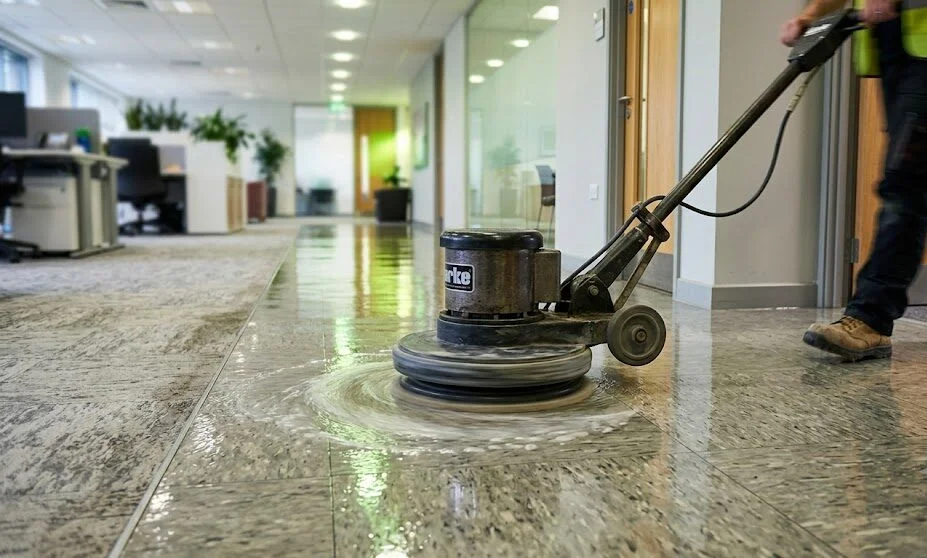
Terrazzo Floors: Honing, Crystallization, and Long-Term Value
Terrazzo is a marble-or-glass-aggregate composite that, properly maintained, can outlast the building around it. But it requires a completely different approach than VCT — no wax finish, no strippers, and pH-neutral cleaning only.
Terrazzo Honing and Crystallization Explained
Instead of stripping and waxing, terrazzo maintenance relies on periodic honing to remove scratches and crystallization to densify and polish the surface chemically. Most commercial terrazzo benefits from crystallization every 3 to 6 months, depending on foot traffic.
Why Terrazzo Loses Its Shine
The most common cause is using generic floor cleaners with the wrong pH, which slowly dulls the aggregate and leaves a filmy residue. The second most common cause is skipping crystallization cycles until the floor needs a full diamond-grinding restoration — a far more expensive fix than staying on schedule.
Polished Concrete: Densifying, Sealing, and Compliance
Polished concrete has become popular in warehouses, industrial complexes, and even modern offices for its durability and low material cost. Low maintenance doesn’t mean no maintenance, though — concrete is still porous and absorbs contamination if it isn’t properly densified and sealed.
Common Concrete Floor Cleaning Mistakes
The biggest mistake we see is treating concrete like VCT: applying wax-based finishes that trap moisture underneath and cause the surface to flake. Concrete needs a penetrating densifier and, where moisture or chemical exposure is a concern, a breathable sealer — never a film-forming one.

CalOSHA and Facility Compliance Considerations
CalOSHA holds facilities responsible for maintaining safe walking surfaces, and slip resistance changes significantly based on how a floor is sealed and cleaned. This is especially important in industries like dialysis centers and medical facilities, where terrazzo and polished concrete are common and patient safety is non-negotiable. Our color-coded microfiber system also plays a role here, keeping floor-cleaning tools separate from those used on other surfaces to prevent cross-contamination in sensitive environments.
Budget-sensitive facilities sometimes ask whether a recurring floor care plan or a one-time restoration makes more sense. In almost every case, recurring maintenance costs less over the life of the floor — deferred care compounds into full restoration work that a maintained schedule would have prevented entirely.
This is also where a customized cleaning plan matters. A property with VCT in the offices, terrazzo in the lobby, and polished concrete in the loading dock needs one vendor managing three protocols correctly — not three separate contracts or one generic one.
How to Build a Floor Care Schedule by Surface Type
Start with a facility walkthrough to identify every surface type, then set a maintenance calendar: daily dust mopping and spot cleaning for all floors, monthly inspection for early wear, and surface-specific deep care (stripping, crystallization, or densifying) on the interval each material requires. An account supervisor who understands these differences is what keeps the schedule from drifting.
Is Your Floor Care Plan Working as Hard as Your Floor Does?
Whatever mix of flooring your facility has, a commercial floor care plan built around each surface type protects your investment and keeps your space looking professional. YSMS has served Bay Area and Tri-Valley facilities for over 26 years, backed by a 98% client retention rate and a 100% satisfaction guarantee with a free re-clean within 24 hours if something isn’t right.
We’ll walk your facility, identify every floor type, and build a maintenance calendar around what each surface actually needs — no long-term contract required. Call (510) 731-8447 for a free facility walkthrough and quote.
Frequently Asked Questions
Most VCT floors need a full strip-and-wax cycle every 6 to 12 months, with burnishing every 1 to 3 months in between to maintain shine without wearing down the finish early.
No. Terrazzo requires pH-neutral, non-acidic cleaners and never a wax finish, while VCT depends on a maintained wax or finish layer. Using VCT products on terrazzo can dull the aggregate and void warranties.
Polished concrete needs less frequent attention than VCT, but it still requires periodic densifying and resealing. Skipping this step lets contamination absorb into the surface and shortens the floor's lifespan.
Honing uses abrasive pads to remove scratches and restore a level surface, while crystallization is a chemical process that densifies and polishes the top layer for shine and stain resistance. Most facilities need both on a rotating schedule.
Yes. Medical and dialysis facilities in San Ramon, Pleasanton, and throughout the Tri-Valley need documented, CalOSHA-compliant floor care with cross-contamination controls, since slip resistance and infection control both depend on how the floor is cleaned and sealed.
If your facility has more than one flooring type, sees regular foot traffic, or has gone more than a year without professional attention, a recurring plan is almost always more cost-effective than waiting for visible damage and paying for full restoration. YSMS's 98% client retention rate reflects how well a properly scheduled plan performs over time.