
If your office windows look hazy just weeks after a cleaning, you are not imagining it. Bay Area commercial windows get dirty faster than nearly anywhere else in California — and the reasons are specific to this region’s environment, not your cleaning crew’s work quality. Understanding what is building up on your glass, and how fast, is the first step toward setting a window cleaning schedule that actually works. This guide covers the main environmental drivers, how often different Bay Area building types need professional attention, and what happens when you fall behind on the schedule. For a broader look at maintaining a clean, professional facility year-round, our Bay Area commercial cleaning services overview is a good place to start.
Why Bay Area Windows Accumulate Grime Faster Than Inland Buildings
The Bay Area sits at the meeting point of marine air, heavy traffic corridors, construction activity, and seasonal pollen cycles. Each of these contributes a different type of surface contamination — and they compound on each other.
1- Salt Particles from the Bay and Ocean Air
Coastal and bay-adjacent buildings deal with salt-laden air year-round. Salt particles are microscopic, sticky, and they bond quickly to glass surfaces. Once bonded, they attract additional airborne debris — pollen, dust, exhaust particulate — creating a layered film that standard wind or rain does not remove.
Left long enough, salt and mineral deposits cause surface etching. Etching is permanent. It means the glass itself is compromised at the surface level, and no amount of cleaning restores full optical clarity afterward. This is not a cosmetic issue — it is an asset protection issue.
2- Traffic Pollution and Exhaust Film
Freeway corridors, BART-adjacent properties, and buildings near industrial zones pick up a thin, oily exhaust film on exterior glass within days of a cleaning. This film looks like haze and worsens under direct sunlight. Buildings near the I-580, I-880, or I-680 corridors see this type of buildup more aggressively than properties in lower-traffic zones.
3- Pollen, Fog, and Construction Dust
Tri-Valley businesses deal with significant spring pollen loads, particularly near open fields and parks. Bay Area fog creates a moisture layer on glass that traps airborne particles rather than rinsing them away. Active construction zones — and there are dozens across the East Bay — generate fine silica and concrete dust that settles heavily on nearby glass surfaces.
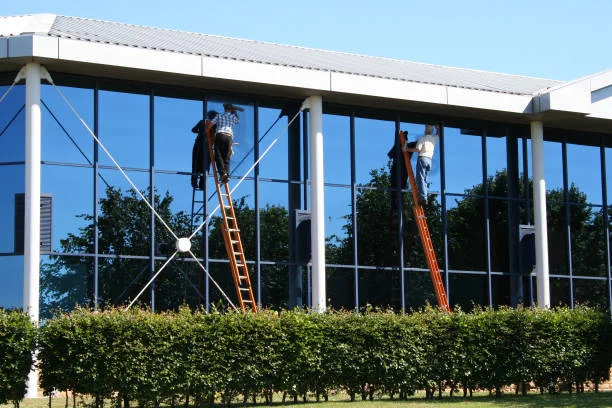
How Often Bay Area Commercial Windows Actually Need to Be Cleaned
There is no single correct answer, but there are reliable benchmarks by building type.
1. Office Buildings and Professional Suites
For standard office buildings with moderate street exposure, professional exterior window cleaning every 4 to 6 weeks is a practical baseline. Interior windows typically need attention every 6 to 8 weeks, driven more by HVAC dust, fingerprints, and cleaning product residue than outdoor pollution.
Buildings with ground-floor retail frontage or heavy pedestrian traffic usually need exterior cleaning every 2 to 4 weeks to maintain the professional appearance that clients and visitors expect.
2. Medical Facilities and Healthcare Environments
Medical facility cleaning follows a tighter logic. Patient and visitor impression management is a direct part of the care environment. Exterior windows should be cleaned monthly at minimum; interior glass — including partition walls, reception windows, and exam room glass — often follows a protocol-driven weekly or biweekly schedule.
Healthcare environments also require cleaners with documented protocols to prevent cross-contamination between surfaces. At YSMS, we use a color-coded microfiber system that keeps glass-cleaning tools separate from other surface contact — the same approach we apply in dialysis centers and medical offices across the Bay Area.
3. Retail and Property Management
Retail storefronts depend on window clarity as a sales tool. Smudged or hazy windows reduce foot traffic and signal poor facility management to prospective customers. A monthly minimum is standard; high-volume retail should schedule every 2 to 3 weeks.
Property managers overseeing multi-unit commercial buildings face a different challenge: consistent execution across common areas and tenant-facing glass. Our property management office cleaning service is specifically structured for this type of ongoing, accountable maintenance.

Signs Your Building Windows Are Overdue for Professional Cleaning
Knowing the schedule is one thing — recognizing when you have already fallen behind is another. Watch for these signals:
1. Visible streaking or haze within 30 days of the last cleaning
2. Interior spaces feel darker despite no change in weather or light
3. Tenants or clients have commented on the appearance
4. Window frames show mineral deposit rings from rain runoff
5. Street-facing glass looks gray or foggy in photographs of your building
If more than two of these apply, your current schedule is not keeping pace with Bay Area environmental conditions. Pairing your window cleaning program with professional janitorial services ensures that the maintenance is consistent rather than reactive.
What Most Facilities Get Wrong About Commercial Window Cleaning
The most common mistake is treating window cleaning as a once-or-twice-a-year task, the way homeowners approach residential windows. Commercial glass faces a completely different exposure level. A residential window might accumulate a quarter-inch of grime buildup over six months. A Bay Area office building on a traffic corridor can reach that same level in three to four weeks.
The second most common mistake is using pressure washing on glass. Power washing is excellent for building facades, concrete, and exterior surfaces — but it is the wrong tool for commercial glass. High-pressure water against glass seals risks gasket damage, seal failure, and streaking that costs more to correct than proper cleaning would have.
Professional window cleaning uses purified water-fed pole systems, correct squeegee technique, and appropriate cleaning agents matched to the surface. For multi-story buildings, the right equipment and training matter as much as the cleaning products used.
Over 26 years of serving Bay Area and Tri-Valley facilities, YSMS has maintained a 98% client retention rate — and a significant part of that consistency comes from account supervisors who check the work against a standard, not just against a task list. When window cleaning is part of a larger commercial cleaning program for office buildings, the scheduling and quality stay tightly coordinated.
Frequently Asked Questions
The combination of marine salt air, bay-side humidity, traffic pollution, and seasonal pollen creates a layered contamination cycle that inland areas simply do not experience. Each element attracts and bonds with the others, building up faster than standard weather patterns can rinse away. Buildings within a mile of the bay or a major freeway corridor feel this most acutely.
Most Bay Area office buildings need exterior window cleaning every 4 to 6 weeks and interior cleaning every 6 to 8 weeks. Ground-floor retail or buildings near high-traffic roads should plan for every 2 to 4 weeks on the exterior. The right frequency depends on your building's location, floor height, and surrounding environmental factors.
Skipping professional cleaning long-term causes real damage. Salt deposits and hard water minerals etch into the glass surface over time, creating a permanent haze that cleaning cannot reverse. At that point, glass replacement is the only solution — a cost far higher than consistent maintenance. Regular cleaning is asset protection, not just appearance management.
Power washing uses high-force water pressure suited for concrete, building facades, and exterior masonry — not glass. Professional window cleaning uses purified water systems, correct squeegee technique, and surface-appropriate solutions that clean without risking seal damage or streaking. Using the wrong method on commercial glass can compromise window gaskets and cause water infiltration.
Tri-Valley cities like Pleasanton and San Ramon deal more with pollen, construction dust, and seasonal wind than with salt air. That means exterior windows may stay cleaner slightly longer — roughly 5 to 7 weeks between professional cleanings for a standard office building. However, businesses near new development zones or open fields often see buildup just as fast as bay-adjacent properties during pollen season.
Every YSMS account is assigned a dedicated account supervisor who reviews the work against a documented standard on each visit. We do not rotate random crews — your building is serviced by a consistent team that knows your property, your schedule, and your expectations. That accountability structure is a core reason our client retention rate has stayed at 98% across 26+ years of Bay Area service. If the result ever falls short, we return within 24 hours at no charge.